Designing for Venmo, one of the top peer-to-peer money transfer apps in the US
Venmo was first founded in 2009. allowing users to transfer money between bank accounts. One of its defining features was a social feed where users could share payment descriptions making finance feel more interactive and social.
Acquired by PayPal in 2013, it added more features later on, such as instant bank transfers, merchant payments, check-out integrations, debit and credit card products, crypto buy and sell, and more.
I was lucky enough to have been a part of this design team for 2.5 years (2023-2026) under the Core team for the most part, contributing to Venmo Business Profiles and Consumer Financial Services. I was the only international designer 🇲🇽 in a team of 10+ talented American designers. Some of my every day tasks consisted of collaborating with other stakeholders across Product, Content, Engineering and Legal.
I had a blast working there and learned so much from everyone 💙
Venmo Business Profiles (VBP)
In 2020 PayPal introduced Venmo Business Profiles for users to keep business and personal payments separate.
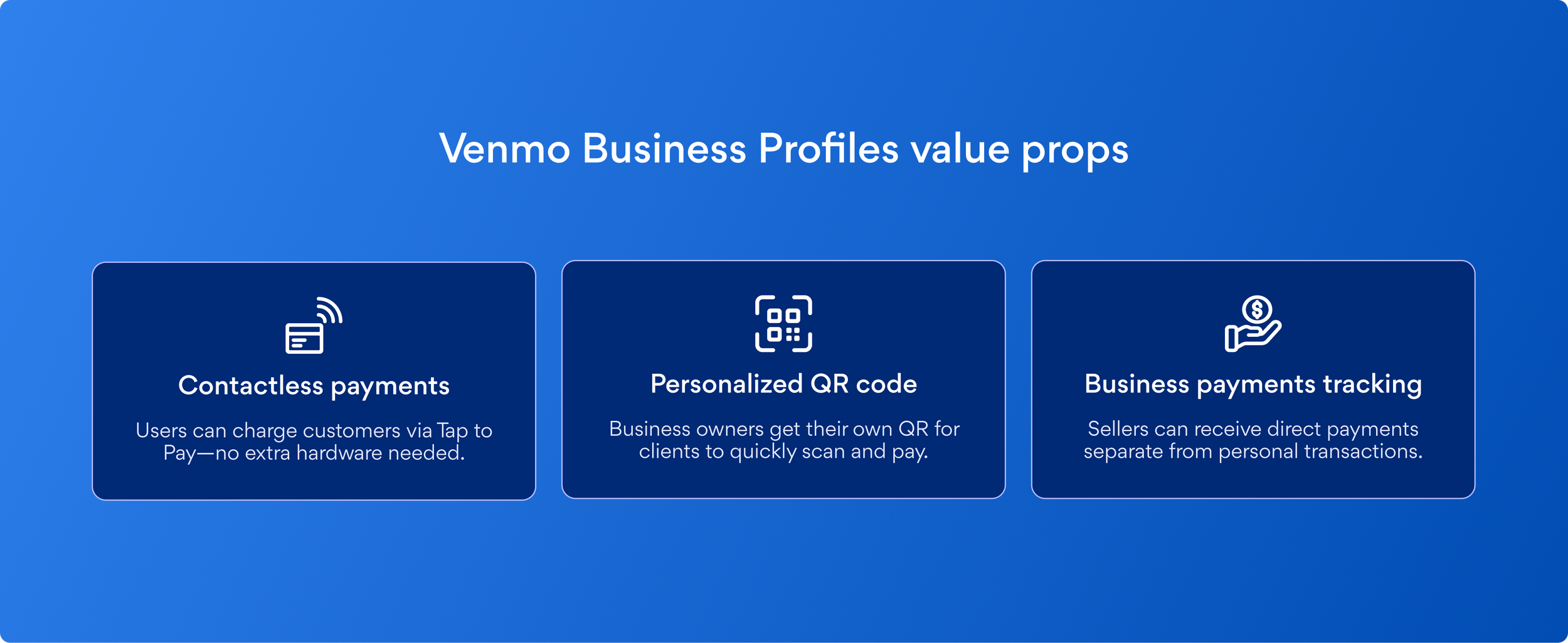
This is a solution envisioned for small businesses, side hustlers, freelancers and overall service providers that wanted to give a more professional look to customers by offering tools such as:
Below is some of the work I did for VBP that successfully shipped 🚀
Charge sheet re-design for Tap to Pay visibility
PROBLEM
VBP sellers aren’t aware of Tap to Pay as a payment option, which offers contactless payments directly in their Venmo app without extra hardware.
GOAL
To increase visibility and adoption of TTP for merchants.
SCOPE AND CONSTRAINTS
This launched as an experiment first, derived from a hypothesis from Product rather than User Research.
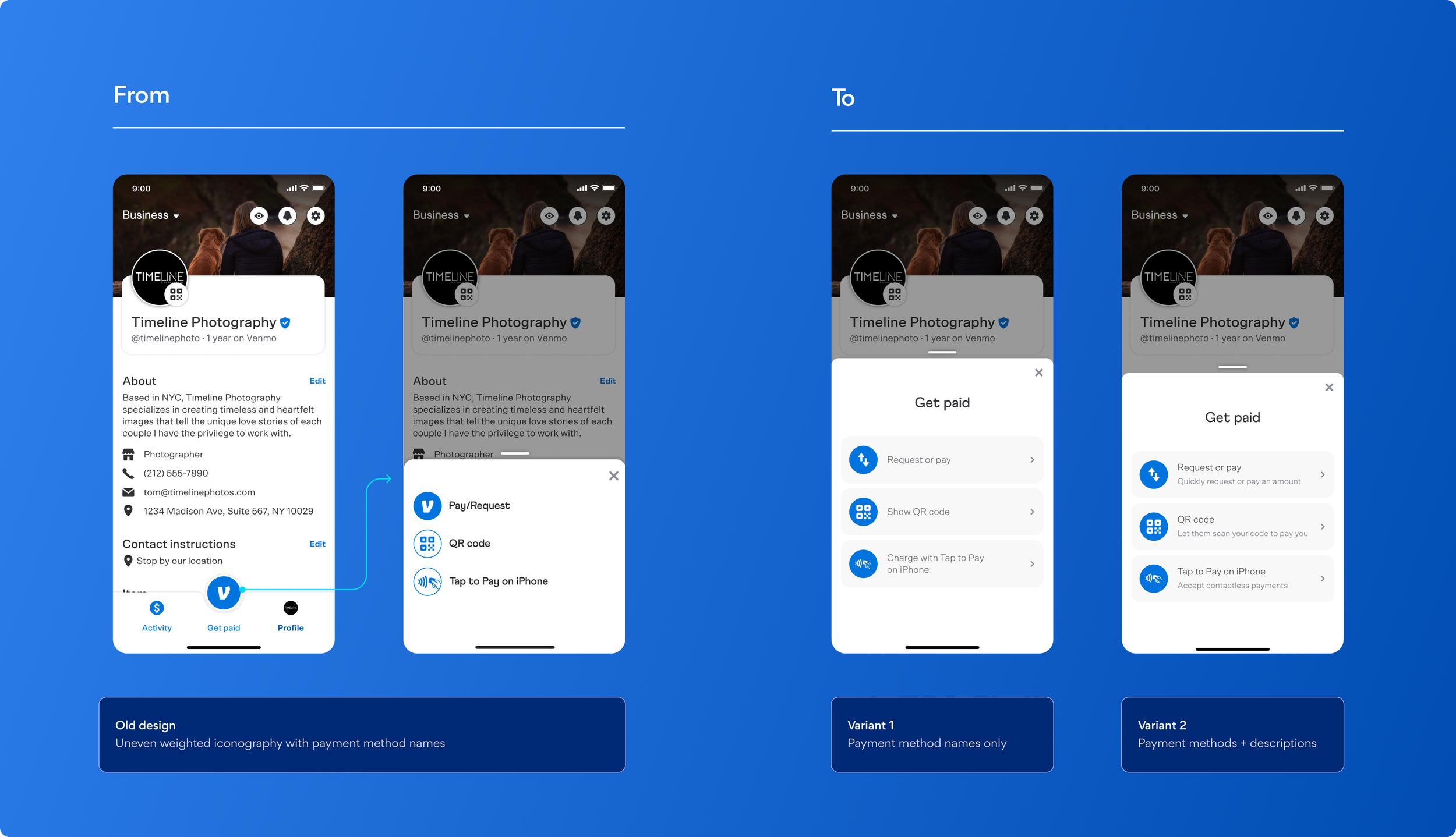
The experiment aimed to elevate Tap to Pay presence in the payment charge sheet options, with the hypothesis that its low usage had to do with the subtleness of the icon, along with a lack of education between all payment methods (Pay/Request, QR code and Tap to Pay).
Both variants presented visual improvements aligned with new UI coming from the redesign efforts that were happening back then, as well as payment methods descriptions. This project required a few feedback sessions for alignment because albeit simple, it required some strategic thinking.
Tap to Pay onboarding page
PROBLEM
Old Tap to Pay landing page didn’t communicate a clear value proposition to merchants.
GOAL
Educate merchants on Tap to Pay benefits to get them to sign up and offer contactless payments via Venmo.
SCOPE AND CONSTRAINTS
Design (and visuals) had to be aligned with Apple’s guides for approval.
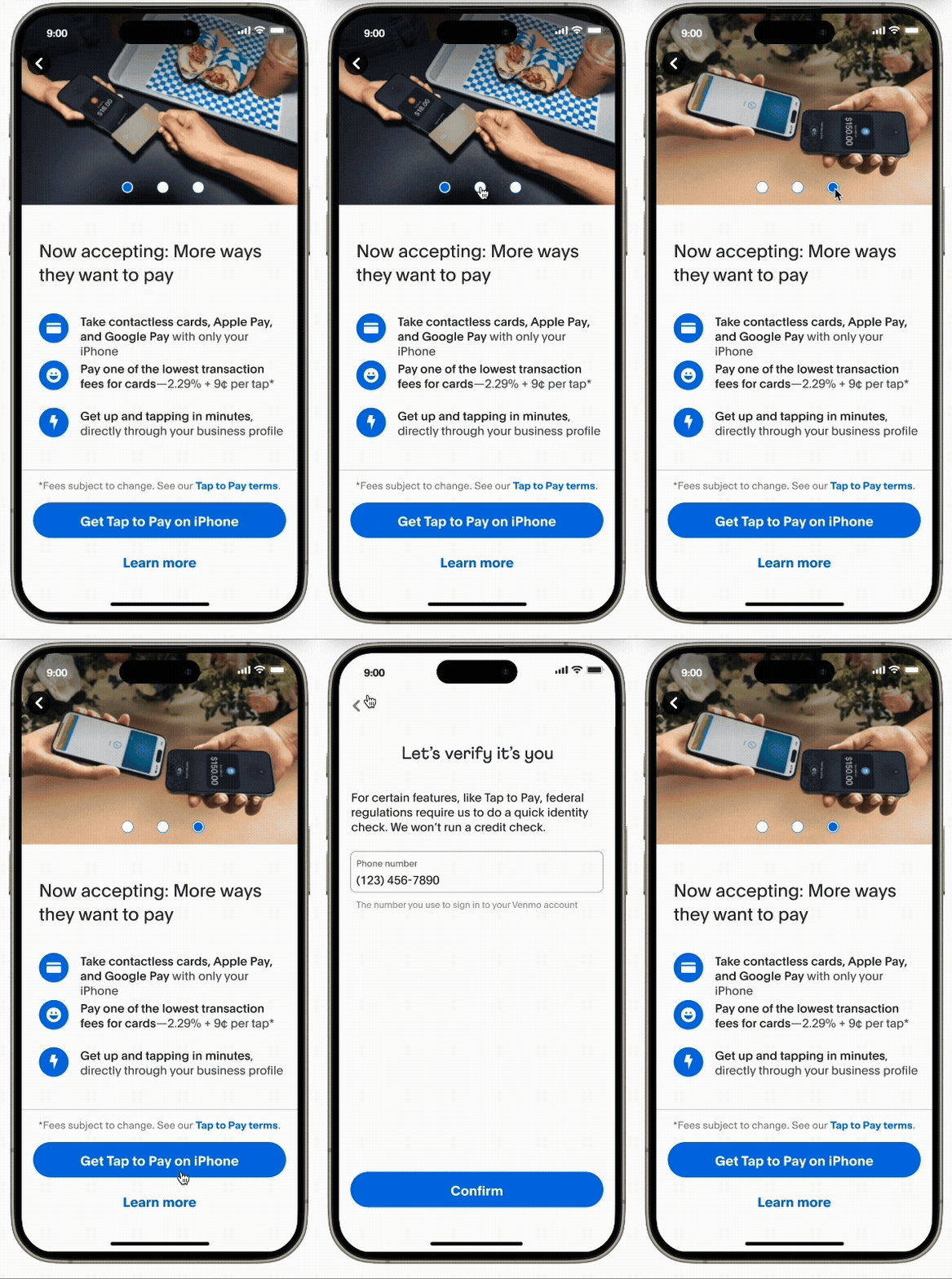
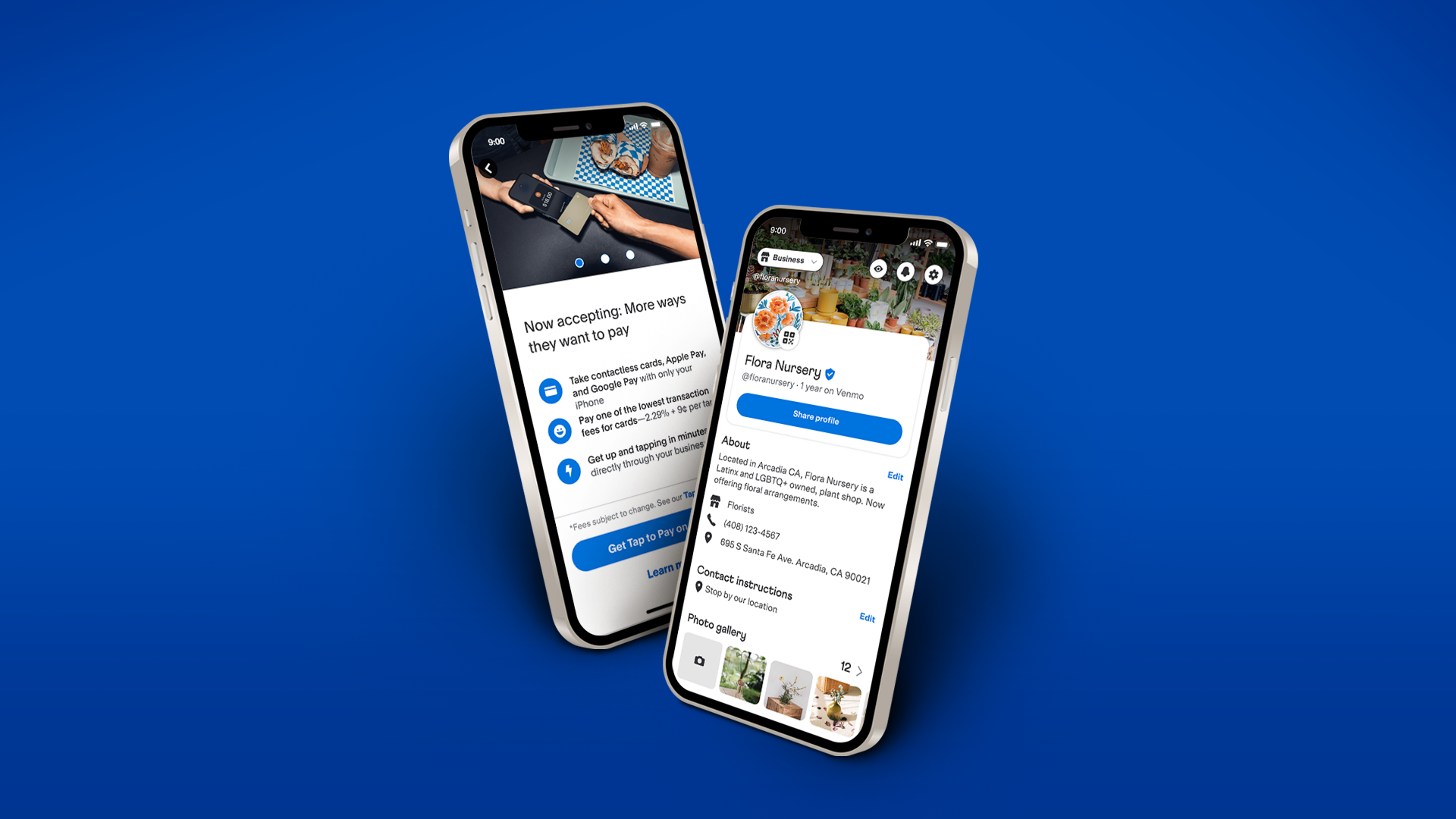
I redesigned Tap to Pay onboarding page which needed to communicate what is it about, its benefits and how can VBP sellers get enrolled.
The version we launched does a better job of communicating the value proposition of TTP and educating users on how to use the product. With this change, we were able to drive a 7.6% overall improvement of our landing page click through rate .
We also saw positive (but not statistically significant) increases in our other key metrics (e.g. full funnel onboarding rates). This project required direct meetings with Apple for approval, which I led from design side.
Profile switcher (Personal and Business profile)
PROBLEM
High volume of misdirected payments between Personal and Business profiles
GOAL
Improve profile type distinction to clearly indicate which one users using and keep payments organized
SCOPE AND CONSTRAINTS
Launched as an experiment
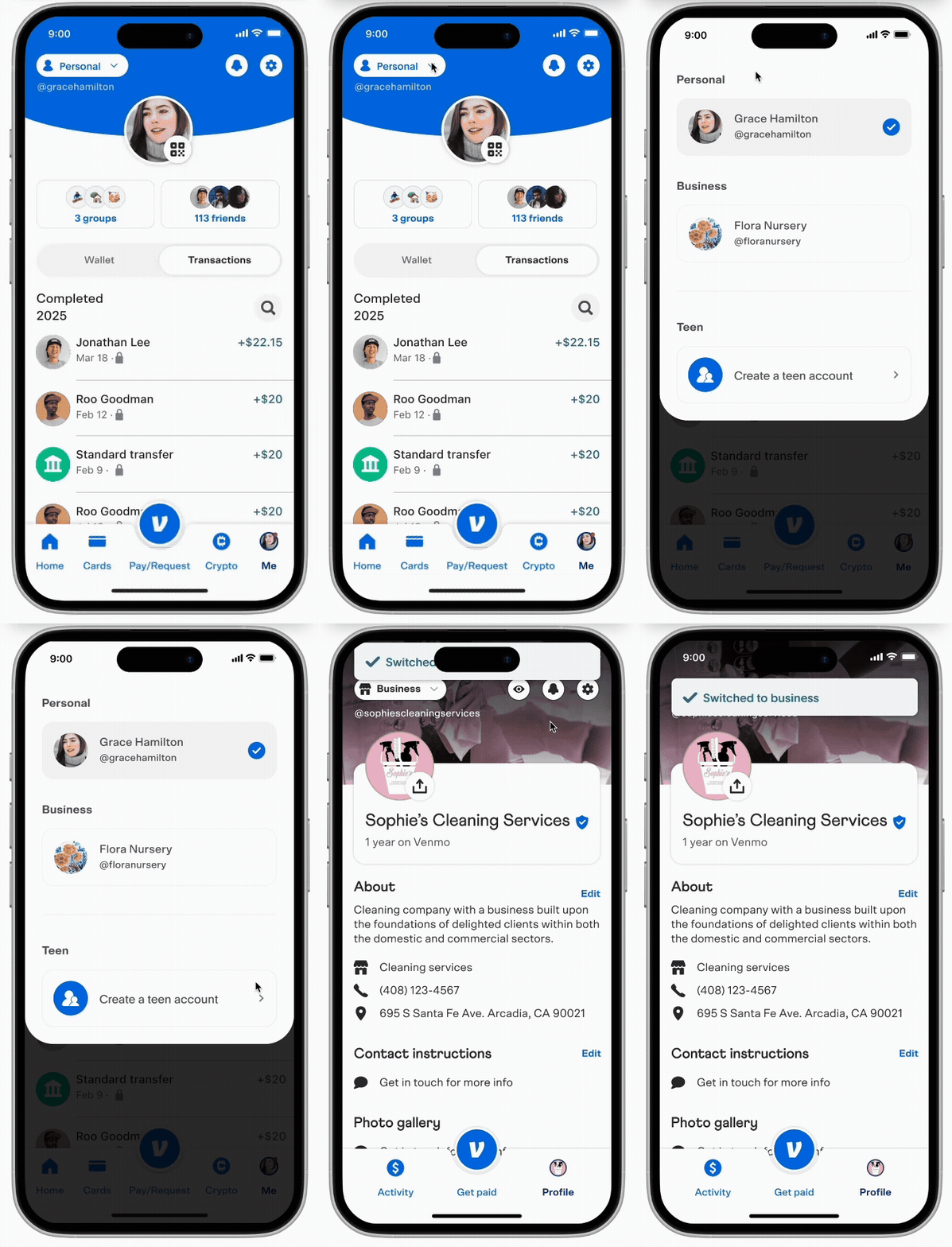
I simplified the profile switcher button, to help users understand where they’re logged into.
This switcher allows users to go back and forth between account types.
A good mount of Venmo Business Profile owners actually haver their name attached to their business, adding up to the confusion on where they’re getting paid. By reducing cognitive load to simple wording like “Personal” and “Business”, we set up users for success and faster profile recognition.
My final proposal ended up being a lot more simplified than what Product was originally proposing.
This resulted in a volume increase of Venmo Business Profile payments by 6.5% on its first 3 weeks live.
Consumer Financial Services (CFS)
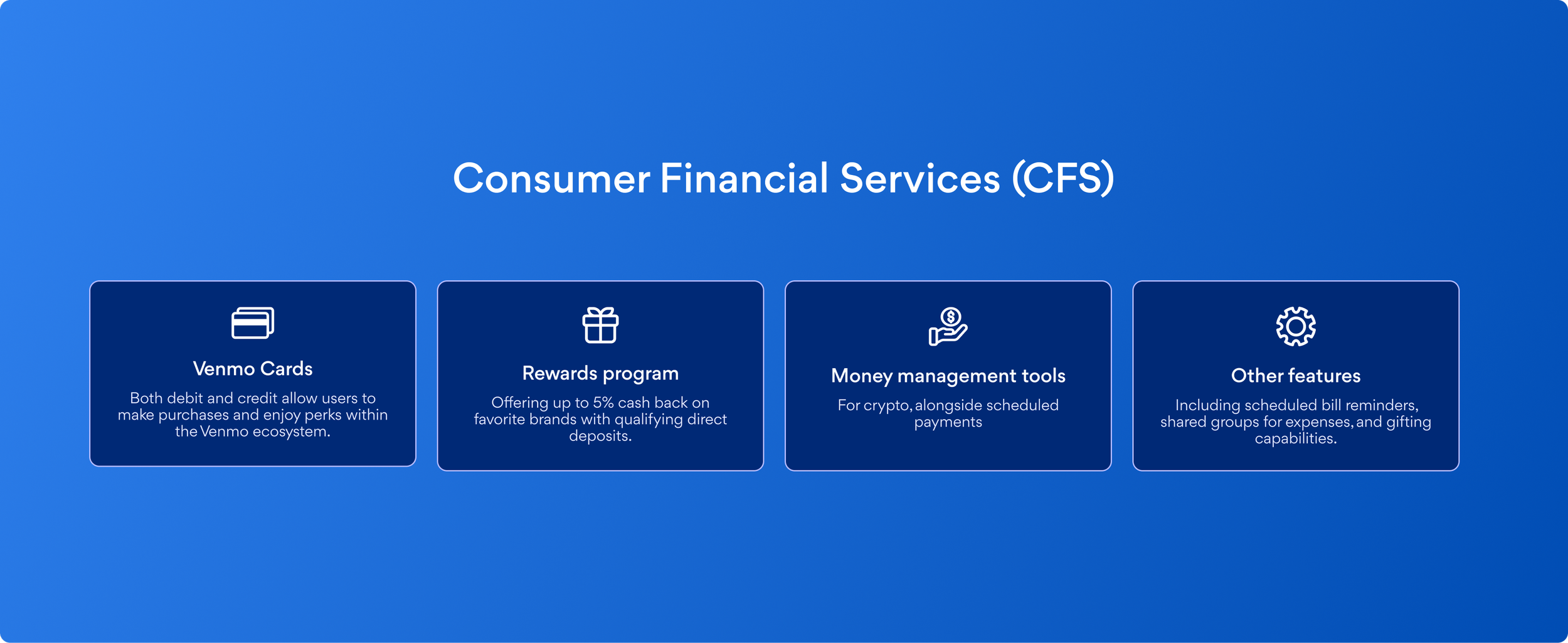
Venmo Consumer Financial Services entails a set of financial products and money movement services that Venmo offers directly to individual consumers, beyond its original peer-to-peer (P2P) payments experience. It is designed to help users send, spend, save, and manage money from within the Venmo app, generally focusing on building financial products that make Venmo feel like more than just a payments app, offering the following:
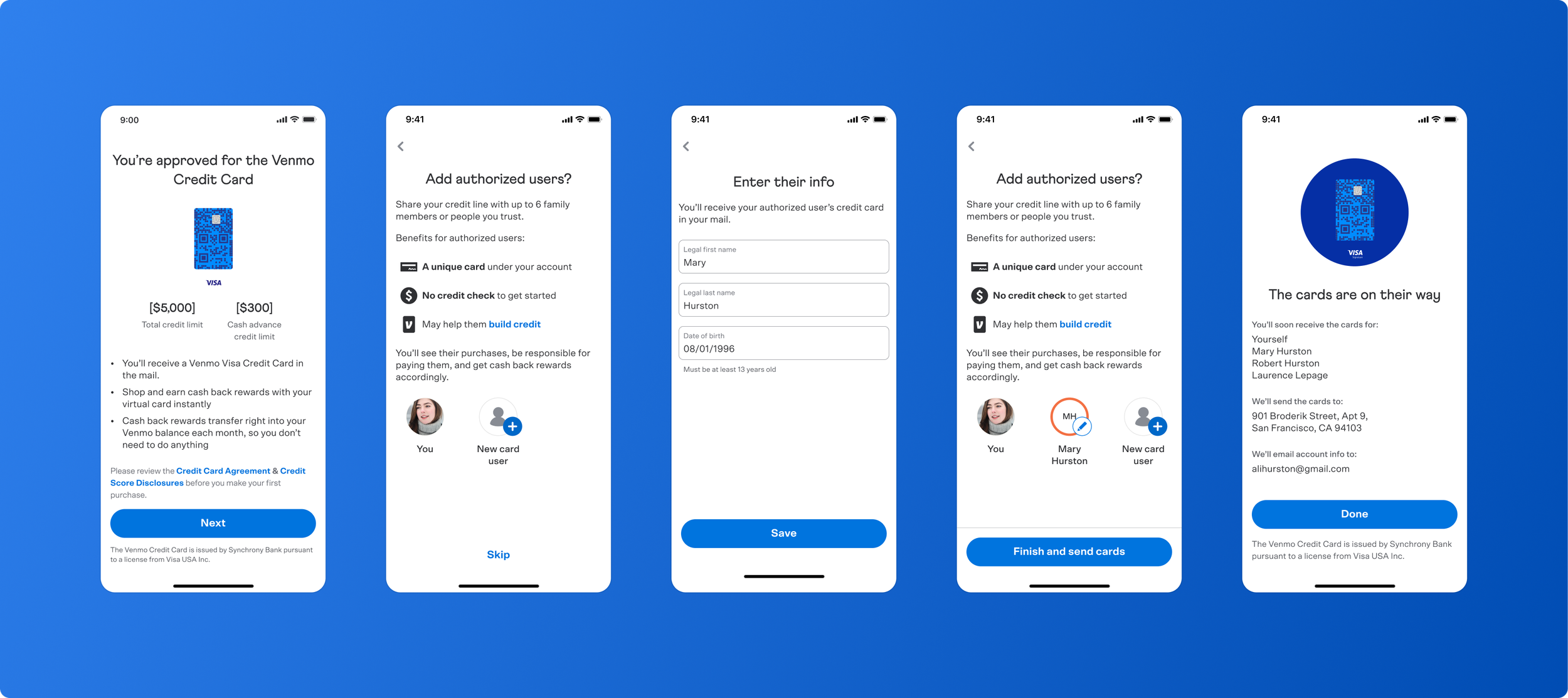
Venmo Credit Card (authorized user)
The Venmo Credit Card is a consumer rewards credit card that allows customers to earn cash back while integrating seamlessly with the Venmo app. It is designed for users who already use Venmo for peer-to-peer payments and want their credit card experience to live within the same ecosystem.
I helped finalize flows for this feature, supported the creation of a few other use cases and supported hand-off with engineering. This marks two accomplishments for VCC: for the first time has the potential lever to penetrate and engage the growing Teens segment. This is also the first ever under all Synchrony's portfolio products that unlocks the ability to do so, which paves the way for other credit portfolios on PayPal side.